UNS Thread Chart, Dimensions, Standard, Angle, Full Form & PDF
If you work with inch-based screw threads, you will eventually run into UNS. Most people learn UNC and UNF first because those are the standard coarse and fine unified threads. UNS sits in the same unified thread family but fills a gap for special diameter-and-pitch combinations that do not fit the fixed TPI rules of UNC, UNF, or UNEF. This guide breaks down the UNS thread, including its meaning, angle, applications, standard, comparison with NPT thread, sizes, and a dimension chart with a downloadable PDF.
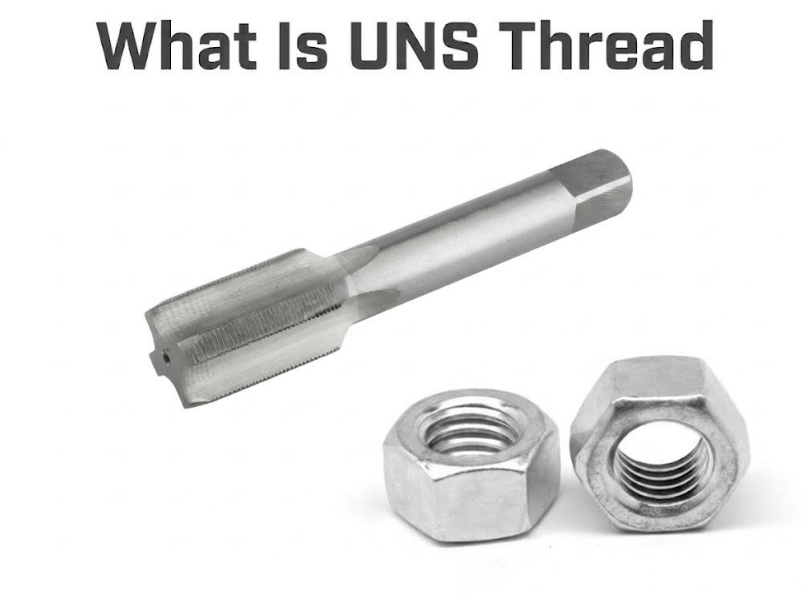
What Is UNS Thread (Full Form & Meaning)
UNS is the abbreviation for Unified National Special thread. It falls under the Unified Inch Thread System covered by ASME B1.1, the primary North‑American standard that defines unified screw thread geometry, series, fit classes, allowances, tolerances, and drawing designations.
Where UNC (Unified National Coarse), UNF (Unified National Fine), and UNEF (Unified National Extra Fine) have one fixed TPI (threads-per-inch) value assigned for each nominal diameter, UNS thread does not use a pre‑defined fixed pitch for a given size. Instead, UNS covers valid special diameter‑to‑TPI combinations documented within ASME B1.1‑2024 tables. Not every arbitrary diameter‑pitch pair qualifies as UNS; only those combinations listed in the official standard are accepted UNS sizes. For example, a nominal 1/2‑inch thread normally uses 13 TPI for UNC. Valid UNS alternatives for this same 1/2‑inch major diameter include 1/2‑12 UNS, 1/2‑14 UNS, 1/2‑18 UNS, 1/2‑24 UNS and 1/2‑27 UNS. Every UNS callout must explicitly write out the TPI value, because no default pitch exists for any UNS nominal size.
UNS Thread Identification and Measurement
To identify an unknown UNS thread, measure the major diameter with a caliper, count the TPI with a thread pitch gauge, then check the combination against the UNS table. If the measured diameter and TPI pair is not listed in UNC or UNF tables but appears in the UNS, it is a UNS thread. Beginners often jump straight to UNF charts and get confused because the TPI does not match the fixed UNF value.
UNS Thread Machining and Tooling
UNS taps are stocked more widely than UNS bolts. This is why UNS is used so often for nuts and tapped holes. When CNC turning UNS threads on a lathe, you set the lathe feed to match the selected TPI, just like any other UN thread. The form tool still uses the 60° UN profile. No special tool shape is needed.
Applications of UNS Threads
Unlike UNC and UNF for standard stock bolts, UNS threads are mostly machined into nuts, tapped holes, and threaded shafts, with UNS taps widely available. Most UNS sizes have higher TPI than equivalent UNF/UNEF threads, offering better tensile strength for high‑stress applications. Engineers choose UNS when standard pitches fail to meet fit, clearance, or load requirements.
Aerospace & Defense: Used for custom structural fasteners and precision components with non‑standard pitches, ensuring stable performance for critical assemblies.
Automotive & Motorsport: Applied on performance spindles and lightweight powertrain hardware to resist vibration and cyclic dynamic loads.
Medical Devices: Delivers precise threaded joints for orthopedic implants and surgical instruments with strict tolerance demands.
Marine & Oil and Gas: Specified for hardware working in harsh conditions, improving reliability under corrosion and fluctuating pressure.
Industrial Machinery & Machine Tools: Common on machine spindles, pressure vessels, and special tooling, where UNC/UNF/UNEF cannot provide required clearance or engagement.
When Not to Use UNS Thread?
If UNC or UNF meets the design load and fit requirements, use those instead. Standard series parts are cheaper, easier to source, and easier for other technicians to identify. UNS is a speciality tool, not a replacement for the standard unified thread series.
Strength and Design Notes
Most UNS threads are chosen for high-stress rotational parts such as spindles. The higher TPI gives more thread engagement over the same length, which spreads load and reduces the chance of thread stripping. But higher TPI also means thinner thread roots. If the material is brittle, the design must balance thread count and root strength.
Common Application Mistakes
The biggest mistake is trying to interchange UNS with UNC or UNF just because the nominal diameter is the same. A 1"-14 UNS nut will not thread onto a 1"-8 UNC bolt. Another common error is mixing UNS with NPT because both can share the same TPI. Always check for taper before assuming a thread is UNS.
UNS Thread Standard
UNS specifications follow the ASME B1.1‑2024 standard, which covers thread form, thread series definitions, fit classes, allowances, dimensional tolerances, and formal drawing notation.
1. Thread Form
The thread form defines core geometry: the fixed 60‑degree included angle, flank geometry, crest and root shape, and thread depth. UNS inherits this exact 60‑degree symmetrical profile from the rest of the UN family.
2. Thread Series
Thread‑series designations (UNC/UNF/UNEF/UNS/UN) define which pitch belongs with each nominal major diameter. UNS is the special‑series branch, limited to diameter‑TPI combinations published in standard tables.
3. Thread Fit Classes
Fit classes define how tight or loose mating internal‑external threads engage, controlling assembly ease, strength, and coating allowance.
External threads (male, bolt/shaft): marked A — 1A (loose), 2A (standard commercial), 3A (precision close fit).
Internal threads (female, nut/tapped hole): marked B — 1B (loose), 2B (standard commercial), 3B (precision close fit).
Use 2A/2B for almost all shop work. 2A/2B is the default general‑shop fit for UNS threads, comparable functionally to ISO‑metric’s common 6g/6H fit combination. Use 3A/3B when the assembly needs precise positioning with minimal play. Use 1A/1B only when you need easier assembly with extra clearance, such as parts that are plated or exposed to dirt.
4. Allowances and Tolerances
Allowance sets the intentional clearance between mating thread parts. Tolerances define permitted dimensional variation for major, minor, and pitch diameters. Consistent tolerance rules apply for UNS just as for UNC/UNF, ensuring interchangeability between parts from different manufacturers.
5. Thread Designation Syntax
A complete UNS drawing label follows this pattern: [Nominal Size]‑[TPI] UNS‑[Fit‑Class]
Example: 1"‑14 UNS‑2A- 1" = nominal major diameter - 14 = threads‑per‑inch (must always be written for UNS) - UNS = series identifier - 2A = external‑thread fit‑class
Internal‑thread counterpart: 1"‑14 UNS‑2B.
When you read a UNS callout, the format follows the same structure as other UN threads: nominal diameter, dash, TPI, UNS, and tolerance class.
Related Unified Thread Definitions (ASME B1.1‑2024)
To understand UNS fully, it helps to know other series within the Unified Inch‑Thread family:
UNC (Unified National Coarse): General‑purpose coarse‑pitch inch threads. Easier assembly, less prone to cross‑threading; widely stocked commodity fasteners.
UNF (Unified National Fine): Fine‑pitch threads offering higher tensile‑stress area for equal diameter, suited for vibration‑prone assemblies and thin‑wall parts.
UNEF (Unified National Extra Fine): Extra‑fine pitch for limited‑engagement or thin‑wall design scenarios.
UN (Unified Constant‑Pitch): Fixed‑TPI series (4, 6, 8, 12, 16, 20, 28, 32 TPI) across multiple diameters, used when UNC‑UNF‑UNEF‑UNS options are insufficient.
UNR: External‑only rolled unified threads with mandatory rounded thread roots for improved fatigue resistance.
UNJC/UNJF: Aerospace‑grade external threads with strictly controlled large root radii to minimize stress concentration and boost fatigue performance.
It is important to note that UNS is not unlimited. Not every possible TPI for every diameter is recognized. Only combinations listed in the ASME tables are valid UNS sizes. If you encounter a random custom pitch that is not listed, it is not a standard UNS thread.
UNS Thread Angle
UNS is still a parallel unified thread with the same 60° V-shaped profile as other UN threads. It is not a separate thread form. This means the two sloped sides of the thread form a 60° V-shape when viewed in cross-section. This angle is fixed and does not change with TPI. It also stays the same whether you are cutting an UNS thread on a lathe, tapping a hole, or checking it with a thread gauge. The 60° profile is what makes UNS interchangeable with other unified thread geometry rules, even though the pitch is special.
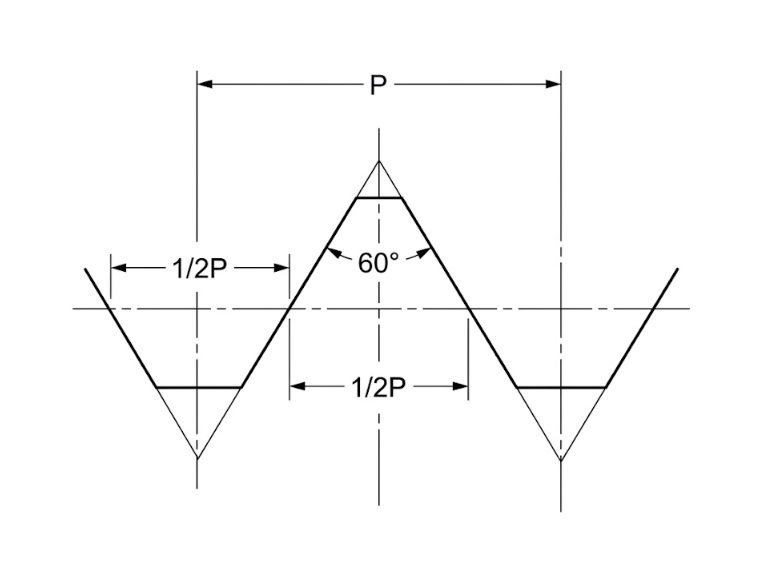
This is one quick way to tell UNS apart from pipe threads like NPT, which also uses 60° flanks but adds a taper. The angle alone is not enough to identify UNS, but it confirms you are still working inside the unified inch family rather than Whitworth, metric, or ACME thread forms.
All unified inch threads share a symmetrical 60‑degree thread profile. Each thread flank tilts 30° relative to the central thread axis, producing the total 60‑degree included angle. This profile geometry is visually identical to ISO‑metric screw threads; the key difference lies in measurement conventions. Unified inch threads specify pitch as TPI (threads per inch), while ISO‑metric threads state pitch directly in millimeters.
UNS vs UNC Thread
UNC is the standard coarse unified thread. Each nominal diameter has one fixed TPI. A 1/2 inch UNC is always 13 TPI. UNS has no fixed TPI for its diameter. You can have 1/2"-12 UNS, 1/2"-14 UNS, 1/2"-18 UNS, and other options, all valid for the same 1/2 inch nominal size.
UNC threads are made for general assembly. They are easier to start, less likely to cross-thread, and more forgiving if the threads are slightly damaged. UNS is selected when the standard coarse or fine pitch does not deliver the needed strength or fit. Since many UNS options use higher TPI, the thread depth is shallower, and the tensile stress area is larger, which improves strength in high-load conditions.
UNC bolts, nuts, and taps are stocked everywhere. UNS hardware is usually custom or machined to order. You will rarely pick up an off-the-shelf UNS bolt, but UNS taps are easy to find for making tapped holes.
A simple comparison: if a drawing calls for a standard, widely available fastener, it is almost always UNC or UNF. If the engineer chose a non-standard pitch to boost strength for a spindle or heavily loaded assembly, it is likely UNS.
UNS vs NPT Thread
This is a very common mix-up in shops, and the difference is critical because they cannot seal or assemble together. NPT stands for National Pipe Taper. It is a tapered pipe thread, while UNS is a straight, parallel unified thread.
| Item | UNS | NPT |
| Thread type | Straight/parallel unified inch thread | Tapered national pipe thread (1 in 16 taper) |
| Primary function | Mechanical fastening, no built‑in sealing | Pressure sealing joint, relies on thread interference plus sealant / PTFE tape |
| Profile angle | 60‑degree included angle | 60‑degree included angle |
| Nominal‑size meaning | Nominal value equals approximate actual major diameter | Nominal pipe size does not equal physical thread major diameter |
| Inter‑compatibility | Cannot assemble with NPT | Cannot assemble with UNS |
Even though both have a 60° flank angle, the taper changes everything. NPT tapers at 1 in 16, so the diameter gets smaller along the thread length. When you tighten NPT male and female threads, the interference between tapered flanks creates a seal, usually with thread sealant or PTFE tape. UNS threads stay straight along their whole length. NPT size names are also confusing. A 1/2" NPT thread does not measure 0.5 inches on the major diameter. Its actual major diameter is about 0.840 inches. A 1/2" UNS thread has a true nominal major diameter of 0.500 inches.
You can use a caliper and thread gauge to separate them. If the thread is straight and the measured major diameter matches the nominal size, and the TPI is a special combination, it is UNS. If the diameter shrinks as you move along the thread, and the nominal label does not match the measured OD, treat it as NPT pipe thread.
UNS Thread Dimensions & Sizes
Thread dimensions for UNS follow the same four core measurements as all UN threads: major diameter, pitch diameter, minor diameter, and pitch.
1. Major diameter: Largest outer dimension of an external thread.
2. Minor diameter: Smallest root dimension of the thread profile.
3. Pitch diameter: Theoretical intermediate diameter where thread‑crest width equals thread‑groove width; pitch diameter is the most critical dimension for evaluating thread fit.
4. Pitch: Distance from one thread crest to the next; calculated as `1 ÷ TPI`.
We will use 1"-14 UNS thread as the example. The nominal major diameter is 1.000 inch (25.4 mm). The TPI is 14, so the pitch equals 1/14 inch, or roughly 1.814 mm.
For class‑2A external 1"‑14 UNS:
- Maximum major diameter = 0.9983 in; minimum major diameter = 0.9880 in
- Pitch‑diameter range: 0.9519 in (max) down to 0.9443 in (min)
- Maximum minor diameter = 0.9132 in
For matching class‑2B internal 1"‑14 UNS:
- Minor‑diameter working range: 0.9224 in minimum to 0.9370 in maximum
- Pitch‑diameter range: 0.9570 in minimum to 0.9652 in maximum
- Minimum internal major diameter = 1.0000 in
Recommended tap‑drill size for 1"‑14 UNS internal tapping is approximately 23.75 mm. When working from drawings, always reference standard limit tables rather than relying only on nominal size. Pitch‑diameter measurements take priority for fit inspection.
UNS Thread Chart
This ASME B1.1 UNS thread dimension chart catalogs valid Unified National Special thread combinations from small #10 sizes up to 6‑inch diameters. Its table columns list the thread designation, nominal size, major diameter in inches and millimeters, recommended tapping drill size (mm), TPI, and pitch (mm).
Key usage notes:
- Inch measurements are the official normative values under ASME B1.1‑2024; all millimeter conversions are for reference only. Do not rely solely on converted metric figures for precision machining.
- The listed tap drill sizes are suggested values, not binding tolerance limits.
- For full tolerance limits across 1A/1B, 2A/2B and 3A/3B fit classes, use ASME B1.1‑compliant thread calculators alongside this chart.
- Disclaimer: All data serves as a practical reference. Production work must conform to the official ASME B1.1 standard and part drawings.
| Nominal Diameter | Major Diameter (in) | Major Diameter (mm) | Tapping Drill Size (mm) | TPI | Pitch (mm) |
|---|---|---|---|---|---|
| 10 - 28 UNS | 0.1900 | 4.826 | 3.95 | 28 | 0.907 |
| 10 - 36 UNS | 0.1900 | 4.826 | 4.15 | 36 | 0.706 |
| 10 - 40 UNS | 0.1900 | 4.826 | 4.20 | 40 | 0.635 |
| 10 - 48 UNS | 0.1900 | 4.826 | 4.35 | 48 | 0.529 |
| 10 - 56 UNS | 0.1900 | 4.826 | 4.39 | 56 | 0.454 |
| 12 - 36 UNS | 0.2160 | 5.486 | 4.80 | 36 | 0.706 |
| 12 - 40 UNS | 0.2160 | 5.486 | 4.90 | 40 | 0.635 |
| 12 - 48 UNS | 0.2160 | 5.486 | 4.98 | 48 | 0.529 |
| 12 - 56 UNS | 0.2160 | 5.486 | 5.05 | 56 | 0.454 |
| 1/4" - 24 UNS | 0.2500 | 6.350 | 5.35 | 24 | 1.058 |
| 1/4" - 27 UNS | 0.2500 | 6.350 | 5.45 | 27 | 0.941 |
| 1/4" - 36 UNS | 0.2500 | 6.350 | 5.70 | 36 | 0.706 |
| 1/4" - 40 UNS | 0.2500 | 6.350 | 5.75 | 40 | 0.635 |
| 1/4" - 48 UNS | 0.2500 | 6.350 | 5.85 | 48 | 0.529 |
| 1/4" - 56 UNS | 0.2500 | 6.350 | 5.95 | 56 | 0.454 |
| 5/16" - 27 UNS | 0.3125 | 7.938 | 7.10 | 27 | 0.941 |
| 5/16" - 36 UNS | 0.3125 | 7.938 | 7.25 | 36 | 0.706 |
| 5/16" - 40 UNS | 0.3125 | 7.938 | 7.40 | 40 | 0.635 |
| 5/16" - 48 UNS | 0.3125 | 7.938 | 7.50 | 48 | 0.529 |
| 3/8" - 18 UNS | 0.3750 | 9.525 | 8.20 | 18 | 1.411 |
| 3/8" - 27 UNS | 0.3750 | 9.525 | 8.70 | 27 | 0.941 |
| 3/8" - 36 UNS | 0.3750 | 9.525 | 8.90 | 36 | 0.706 |
| 3/8" - 40 UNS | 0.3750 | 9.525 | 9.00 | 40 | 0.635 |
| 0.390" - 27 UNS | 0.3900 | 9.906 | 9.00 | 27 | 0.941 |
| 7/16" - 18 UNS | 0.4375 | 11.112 | 9.75 | 18 | 1.411 |
| 7/16" - 24 UNS | 0.4375 | 11.112 | 10.10 | 24 | 1.058 |
| 7/16" - 27 UNS | 0.4375 | 11.112 | 10.20 | 27 | 0.941 |
| 1/2" - 12 UNS | 0.5000 | 12.700 | 10.75 | 12 | 2.117 |
| 1/2" - 14 UNS | 0.5000 | 12.700 | 11.00 | 14 | 1.814 |
| 1/2" - 18 UNS | 0.5000 | 12.700 | 11.40 | 18 | 1.411 |
| 1/2" - 24 UNS | 0.5000 | 12.700 | 11.70 | 24 | 1.058 |
| 1/2" - 27 UNS | 0.5000 | 12.700 | 11.85 | 27 | 0.941 |
| 9/16" - 14 UNS | 0.5625 | 14.288 | 12.60 | 14 | 1.814 |
| 9/16" - 27 UNS | 0.5625 | 14.288 | 13.40 | 27 | 0.941 |
| 5/8" - 14 UNS | 0.6250 | 15.875 | 14.20 | 14 | 1.814 |
| 5/8" - 27 UNS | 0.6250 | 15.875 | 15.00 | 27 | 0.941 |
| 3/4" - 14 UNS | 0.7500 | 19.050 | 17.40 | 14 | 1.814 |
| 3/4" - 18 UNS | 0.7500 | 19.050 | 17.75 | 18 | 1.411 |
| 3/4" - 24 UNS | 0.7500 | 19.050 | 18.10 | 24 | 1.058 |
| 3/4" - 27 UNS | 0.7500 | 19.050 | 18.20 | 27 | 0.941 |
| 7/8" - 10 UNS | 0.8750 | 22.225 | 19.75 | 10 | 2.540 |
| 7/8" - 18 UNS | 0.8750 | 22.225 | 21.00 | 18 | 1.411 |
| 7/8" - 24 UNS | 0.8750 | 22.225 | 21.20 | 24 | 1.058 |
| 7/8" - 27 UNS | 0.8750 | 22.225 | 21.40 | 27 | 0.941 |
| 1" - 10 UNS | 1.0000 | 25.400 | 23.00 | 10 | 2.540 |
| 1" - 14 UNS | 1.0000 | 25.400 | 23.75 | 14 | 1.814 |
| 1" - 18 UNS | 1.0000 | 25.400 | 24.25 | 18 | 1.411 |
| 1" - 24 UNS | 1.0000 | 25.400 | 24.50 | 24 | 1.058 |
| 1" - 27 UNS | 1.0000 | 25.400 | 24.50 | 27 | 0.941 |
| 1 1/8" - 10 UNS | 1.1250 | 28.575 | 26.25 | 10 | 2.540 |
| 1 1/8" - 14 UNS | 1.1250 | 28.575 | 27.00 | 14 | 1.814 |
| 1 1/8" - 24 UNS | 1.1250 | 28.575 | 27.75 | 24 | 1.058 |
| 1 1/4" - 10 UNS | 1.2500 | 31.750 | 29.50 | 10 | 2.540 |
| 1 1/4" - 14 UNS | 1.2500 | 31.750 | 30.00 | 14 | 1.814 |
| 1 1/4" - 24 UNS | 1.2500 | 31.750 | 30.75 | 24 | 1.058 |
| 1 3/8" - 10 UNS | 1.3750 | 34.925 | 32.60 | 10 | 2.540 |
| 1 3/8" - 14 UNS | 1.3750 | 34.925 | 33.30 | 14 | 1.814 |
| 1 1/2" - 10 UNS | 1.5000 | 38.100 | 35.70 | 10 | 2.540 |
| 1 1/2" - 14 UNS | 1.5000 | 38.100 | 36.50 | 14 | 1.814 |
| 1 1/2" - 24 UNS | 1.5000 | 38.100 | 37.30 | 24 | 1.058 |
| 1 5/8" - 10 UNS | 1.6250 | 41.275 | 39.00 | 10 | 2.540 |
| 1 5/8" - 14 UNS | 1.6250 | 41.275 | 39.50 | 14 | 1.814 |
| 1 5/8" - 24 UNS | 1.6250 | 41.275 | 40.35 | 24 | 1.058 |
| 1 3/4" - 10 UNS | 1.7500 | 44.450 | 42.00 | 10 | 2.540 |
| 1 3/4" - 14 UNS | 1.7500 | 44.450 | 42.85 | 14 | 1.814 |
| 1 3/4" - 18 UNS | 1.7500 | 44.450 | 43.25 | 18 | 1.411 |
| 1 7/8" - 10 UNS | 1.8750 | 47.625 | 45.30 | 10 | 2.540 |
| 1 7/8" - 14 UNS | 1.8750 | 47.625 | 46.00 | 14 | 1.814 |
| 1 7/8" - 18 UNS | 1.8750 | 47.625 | 46.35 | 18 | 1.411 |
| 2" - 10 UNS | 2.0000 | 50.800 | 48.40 | 10 | 2.540 |
| 2" - 14 UNS | 2.0000 | 50.800 | 49.25 | 14 | 1.814 |
| 2" - 18 UNS | 2.0000 | 50.800 | 49.50 | 18 | 1.411 |
| 2 1/16" - 16 UNS | 2.0625 | 52.387 | 51.00 | 16 | 1.587 |
| 2 3/16" - 16 UNS | 2.1875 | 55.563 | 54.10 | 16 | 1.587 |
| 2 1/4" - 10 UNS | 2.2500 | 57.150 | 54.75 | 10 | 2.540 |
| 2 1/4" - 14 UNS | 2.2500 | 57.150 | 55.50 | 14 | 1.814 |
| 2 1/4" - 18 UNS | 2.2500 | 57.150 | 55.75 | 18 | 1.411 |
| 2 5/16" - 16 UNS | 2.3125 | 58.737 | 57.30 | 16 | 1.587 |
| 2 7/16" - 16 UNS | 2.4375 | 61.912 | 60.50 | 16 | 1.587 |
| 2 1/2" - 10 UNS | 2.5000 | 63.500 | 61.20 | 10 | 2.540 |
| 2 1/2" - 14 UNS | 2.5000 | 63.500 | 61.75 | 14 | 1.814 |
| 2 1/2" - 18 UNS | 2.5000 | 63.500 | 62.30 | 18 | 1.411 |
| 2 3/4" - 10 UNS | 2.7500 | 69.850 | 67.50 | 10 | 2.540 |
| 2 3/4" - 14 UNS | 2.7500 | 69.850 | 68.25 | 14 | 1.814 |
| 2 3/4" - 18 UNS | 2.7500 | 69.850 | 68.50 | 18 | 1.411 |
| 3" - 10 UNS | 3.0000 | 76.200 | 73.80 | 10 | 2.540 |
| 3" - 14 UNS | 3.0000 | 76.200 | 74.50 | 14 | 1.814 |
| 3" - 18 UNS | 3.0000 | 76.200 | 75.00 | 18 | 1.411 |
| 3 1/4" - 10 UNS | 3.2500 | 82.550 | 80.25 | 10 | 2.540 |
| 3 1/4" - 14 UNS | 3.2500 | 82.550 | 81.00 | 14 | 1.814 |
| 3 1/4" - 18 UNS | 3.2500 | 82.550 | 81.25 | 18 | 1.411 |
| 3 1/2" - 10 UNS | 3.5000 | 88.900 | 86.55 | 10 | 2.540 |
| 3 1/2" - 14 UNS | 3.5000 | 88.900 | 87.25 | 14 | 1.814 |
| 3 1/2" - 18 UNS | 3.5000 | 88.900 | 87.60 | 18 | 1.411 |
| 3 3/4" - 10 UNS | 3.7500 | 95.250 | 93.00 | 10 | 2.540 |
| 3 3/4" - 14 UNS | 3.7500 | 95.250 | 93.60 | 14 | 1.814 |
| 3 3/4" - 18 UNS | 3.7500 | 95.250 | 94.00 | 18 | 1.411 |
| 4" - 10 UNS | 4.0000 | 101.600 | 99.30 | 10 | 2.540 |
| 4" - 14 UNS | 4.0000 | 101.600 | 100.00 | 14 | 1.814 |
| 4 1/4" - 10 UNS | 4.2500 | 107.950 | 105.60 | 10 | 2.540 |
| 4 1/4" - 14 UNS | 4.2500 | 107.950 | 106.30 | 14 | 1.814 |
| 4 1/2" - 10 UNS | 4.5000 | 114.300 | 112.00 | 10 | 2.540 |
| 4 1/2" - 14 UNS | 4.5000 | 114.300 | 112.65 | 14 | 1.814 |
| 4 3/4" - 10 UNS | 4.7500 | 120.650 | 118.35 | 10 | 2.540 |
| 4 3/4" - 14 UNS | 4.7500 | 120.650 | 119.00 | 14 | 1.814 |
| 5" - 10 UNS | 5.0000 | 127.000 | 124.70 | 10 | 2.540 |
| 5" - 14 UNS | 5.0000 | 127.000 | 125.35 | 14 | 1.814 |
| 5 1/4" - 10 UNS | 5.2500 | 133.350 | 131.00 | 10 | 2.540 |
| 5 1/4" - 14 UNS | 5.2500 | 133.350 | 131.70 | 14 | 1.814 |
| 5 1/2" - 10 UNS | 5.5000 | 139.700 | 137.40 | 10 | 2.540 |
| 5 1/2" - 14 UNS | 5.5000 | 139.700 | 138.00 | 14 | 1.814 |
| 5 3/4" - 10 UNS | 5.7500 | 146.050 | 143.75 | 10 | 2.540 |
| 5 3/4" - 14 UNS | 5.7500 | 146.050 | 144.40 | 14 | 1.814 |
| 6" - 10 UNS | 6.0000 | 152.400 | 150.00 | 10 | 2.540 |
| 6" - 14 UNS | 6.0000 | 152.400 | 150.75 | 14 | 1.814 |
UNS Thread Chart PDF